
Description
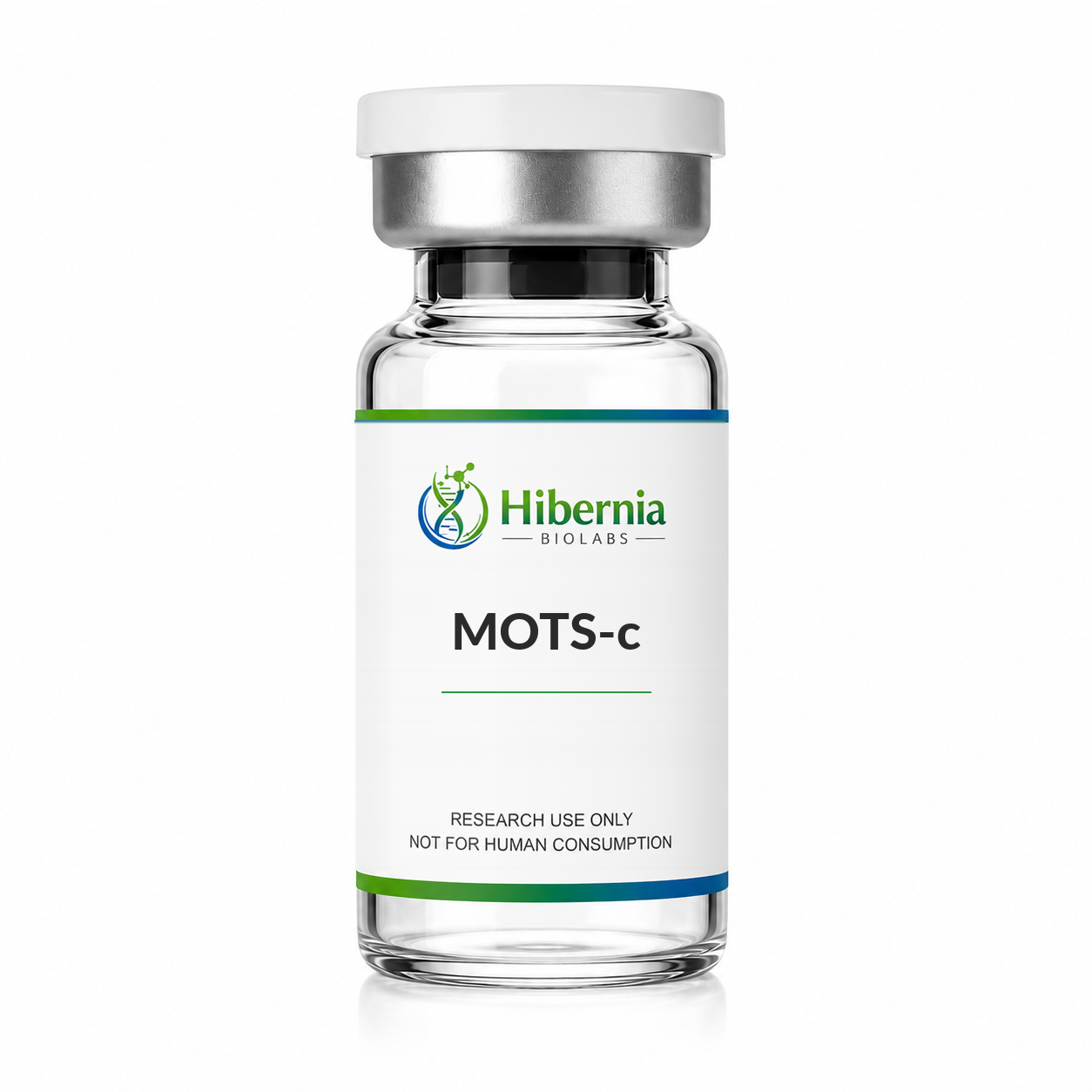
MOTS-c (Human) – research-grade investigational mitochondrial-derived peptide
MOTS-c, short for mitochondrial open reading frame of the 12S rRNA type-c, is a 16-amino-acid mitochondrial-derived peptide. The human sequence is Met-Arg-Trp-Gln-Glu-Met-Gly-Tyr-Ile-Phe-Tyr-Pro-Arg-Lys-Leu-Arg. Research material labelled “MOTS-c (Human)” generally refers to a synthetic version of this naturally occurring human peptide sequence rather than material extracted from human tissue.
Within laboratory and preclinical research contexts, MOTS-c is of interest because it represents a form of communication between the mitochondrial and nuclear genomes. Studies have examined its involvement in cellular stress adaptation, skeletal-muscle metabolism, AMPK-associated signalling and the regulation of nuclear gene expression.
Research relevance of MOTS-c
MOTS-c is commonly associated with:
- Investigation of mitochondrial-derived peptide signalling
- Studies involving folate, purine-biosynthesis and AMPK-related pathways
- Experimental analysis of skeletal-muscle metabolism and insulin signalling
- Research into cellular responses to metabolic and oxidative stress
- Investigation of exercise adaptation, ageing and metabolic homeostasis
Scientific research background
The original MOTS-c study identified a short open reading frame within mitochondrial 12S rRNA that encodes the peptide. In cell and rodent models, researchers examined its influence on the folate cycle, de novo purine biosynthesis, AMPK activation, skeletal-muscle glucose metabolism and metabolic homeostasis.
Separate research reported that endogenous MOTS-c levels increased in skeletal muscle and circulation following exercise in a small group of healthy men. In the same publication, administration of synthetic MOTS-c was studied in cultured cells and mice, where researchers examined physical performance, skeletal-muscle metabolism, stress adaptation and age-related physiological decline. The human portion measured naturally produced MOTS-c and did not evaluate administration of synthetic MOTS-c to people.
The available evidence for externally administered MOTS-c remains predominantly laboratory-based and preclinical. The FDA reports that it has not identified clinical studies or human-exposure data for administered MOTS-c products. It has also identified unresolved concerns involving immunogenicity, aggregation, peptide-related impurities and active-ingredient characterisation. These findings should not be interpreted as confirmed therapeutic outcomes in humans.
The designation “MOTS-c (Human)” does not by itself establish whether the material is supplied as the free base or acetate salt. These are distinct chemical forms, and the exact sequence, molecular form, identity and purity should be confirmed through appropriate analytical documentation.
Scientific reference
Lee C et al. The mitochondrial-derived peptide MOTS-c promotes metabolic homeostasis and reduces obesity and insulin resistance. Cell Metabolism, 2015.
FOR RESEARCH USE ONLY
IMPORTANT INFORMATION
- This substance is supplied strictly for laboratory research purposes.
- It is not a food product.
- It is not a dietary supplement.
- It is not an authorised medicinal product.
- It is not intended for human or animal consumption.
- It is not intended for injection, oral administration or nasal administration.
- “Human” describes the referenced peptide sequence and does not mean the material was extracted from human tissue.
- The product name does not by itself confirm its identity, sequence, salt form, concentration, purity or sterility.
- Keep out of reach of children.
- Keep the container sealed when not in use.
- Store in the original container only.
- Store according to the conditions stated on the product label or certificate of analysis.
- Protect from moisture, excessive heat and direct sunlight.
- Avoid handling during pregnancy or breastfeeding.
In the event of accidental exposure, irritation, illness or any adverse reaction, seek medical advice.






Reviews
There are no reviews yet.